Photo: Connie Tsang
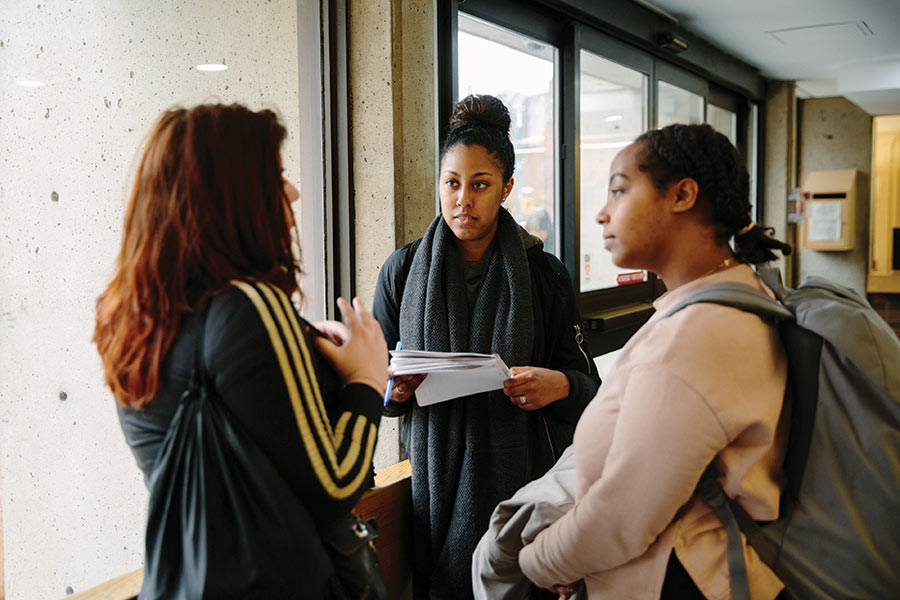
New College’s interdisciplinary programs move beyond traditional academic fields to critically examine real-world issues through the lens of equity, diversity, and social justice.
They share a commitment to broaden and enrich student experience through close collaborations with local and international community partners.
Critical Studies in Equity and Solidarity (CSES)
How do we think about equity and social justice in a politically complex and rapidly changing world? Critical Studies in Equity and Solidarity is an interdisciplinary program (Major, Minor) that supports students in developing a deep understanding of social in/equities across both local and global contexts. Bridging a range of academic disciplines—such as education, sociology, political science, and history—the program integrates scholarship, real-world practice, and activism through a distinctive approach to undergraduate education that prioritizes experiential learning and community engagement.
CSES students explore theoretical and historical texts in areas such as critical race and anti-colonial thought, transnational feminism, critical disability studies, queer theory, and food equity and justice. With a strong emphasis on community engagement and the ongoing work of building solidarities across diverse movements and communities, the program equips students not only with theoretical frameworks but also with the practical tools needed to work toward meaningful social transformation. Graduates often go on to pursue advanced studies in fields such as law, education, public policy, social work, and health, or to build impactful careers in the non-profit and public sectors.
Community Engaged Learning (CEL)
Thinking ahead to your senior years? New College offers several community-engaged courses, including our upper-year Community Engaged Learning Seminars. These courses provide third and fourth year students the opportunity to integrate academic, experiential and practice-based learning as they participate in meaningful work in community or campus organizations.
Upper-level students, with various academic backgrounds, are placed with a grassroots, community or campus-based organization for several hours per week, contributing to the mission of that organization through program support work or research.